Exhibitions
Traces of Life
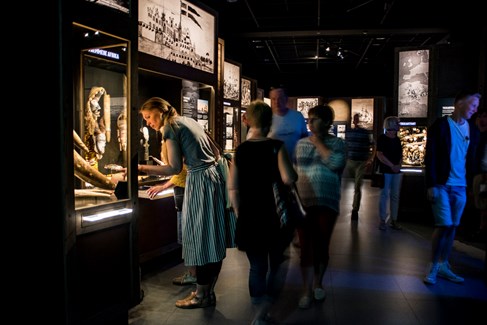
Traces of Life’ presents traces of life in Eastern Agder from the Stone Age, Bronze Age and Iron Age. The exhibition covers the period from when the first humans arrived in the area until the end of the Viking Age. The exhibition focuses on the eastern part of Agder but is also relevant to the rest of the Agder region.
Traces of Life is filled with unique objects, activities for children, digital info stations and magical animations.
The exhibition is broadly based on KUBEN’s own archaeological collection. In addition to our own archaeological artefacts we have also been able to borrow objects from the Department of Cultural History at the University Museum in Bergen.
Every year archaeological objects are uncovered by both archaeologists and members of the public. The section of the exhibition called “New traces of life!” displays recent archaeological finds from the region.
Enslaved
This exhibition tells the story of the final voyage of the slave ship «Fredensborg». The frigate «Fredensborg» left Copenhagen in June 1767. Equipped for a triangular trade voyage, the ship was loaded with weapons, gunpowder and spirits, which were to be traded for African slaves. The slaves were to be transported to St. Croix in the Caribbean, and valuable sugar brought back to Copenhagen. But the «Fredensborg» never came home. She was wrecked off Tromøy on December 1st, 1768.
The exhibition also focuses on slavery today. Who made your things? Slavery still exists, and it also affects you.
Childhood
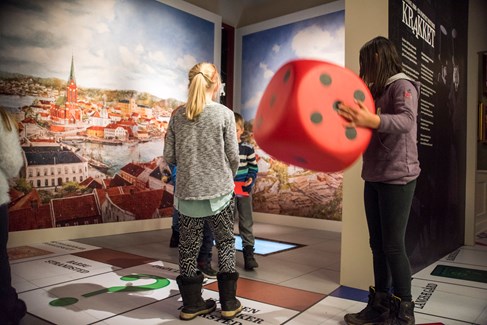
Get a glimpse of how it was to be a child in the 20th century. The exhibition Barndom (Childhood) is made primarily for children, and it has several activities for the kids. You’ll find a combination of fun and facts for children and adults. You can travel with a time machine, and then try to milk a cow, raise a sail, sing skipping-rope rhymes or simply dress up in old and fancy costumes.
The white sails
Stories from the final years of Norways sailingships. 150 years ago, Norway had the third largest merchant navy in the world, and Southern Norway was home to the bulk of the country’s sailing ships. Agder’s vast forests provided timber for shipbuilding. The Golden Age was replaced by periods of political and economic crisis, and sailing ships disappeared from the fleet. Steamships were the future.
The exhibition is based on KUBEN’s sailing ship archive, as a part of Norway's document heritage, a national version of UNESCO's Memory of the world program.
Open Storage - Game On
Games have always been an important part of human life – for fun, learning, and being together. The exhibition “Game On” offers a glimpse into what children and adults in Agder have played for more than 250 years, from board games and cards to tombola and video games. You might even rediscover an old favourite.
In Open Storage, 326 objects are displayed, ranging from well-known classics to surprises. The oldest item is a card game from 1759, Kongelige Jagt Skaaler. Visitors can also see local games like Arendalsspillet and Finansspillet, as well as more exotic items such as a beautifully decorated 19th‑century chessboard from China. Larger objects are also on display, including a homemade 1930s prize wheel from Lillesand and a wooden bird used as a shooting target by the Arendal Bird‑Shooting Society.
About the “Open Storage” Room
Open Storage gives visitors a rare look into the breadth of KUBEN’s collections. Here we can showcase a large number of objects that are normally kept in storage.
KUBEN’s storage hold nearly 50,000 items, preserved under stable climate conditions to ensure their long-term protection.
The Bank Crash
The bank crash in Arendal came like a thunderbolt one fine autumn day in 1886. Fraud, excessive borrowing and favouritism led to a bank crash and bankruptcies. The working class organised, and in October, there was almost a revolution in the small town.
Arne Vinje Gunnerud sculpture
Arne Vinje Gunnerud was a great Norwegian sculptor who, for the majority of his life, lived in Arendal. Through prehistoric art and Norse mythology he discovered metaphors that also could describe modern issues. Gunnerud worked predominantly in bronze, wood and stone. He was very productive and he had many exhibitions both at home and abroad.
The Boat Travellers
The exhibition presents rare photographs of the Romani people who lived along the coast.
The Romani arrived in Scandinavia in the early 1500s and made their living as travelling craftsmen, traders, musicians, and storytellers. Along the coasts of Western and Southern Norway, they became known as the boat travellers—families who lived and journeyed by boat and who occupied a distinctive place on the margins of society. The boat served as both home and means of transport.
At the heart of the exhibition are the photographs taken by Birger Dannevig, who visited the boat‑travelling Bredesen family in the archipelago outside Arendal in 1946 and 1948. Dannevig captured several images of the family, and his ability to connect closely with his subjects gives the photographs a rare human depth and an authentic glimpse into a culture that was on the verge of disappearing.